Showing posts with label management. Show all posts
Thursday, January 3, 2019
Is our old manager a senior manager or a director now?
I guess it's better than everyone getting demoted one level?
Snarky: They promoted you too? So we're all managers?
Title: Is our old manager a senior manager or a director now?
Thursday, October 10, 2013
But wouldn't that imply you ever were?
Post-technical is not a term I've heard to describe someone who has moved beyond developer into the ranks of management. It's rather appropriate to be sure, but when a friend described himself as such over dinner last week, I couldn't help but laugh.
Title: But wouldn't that imply you ever were?
Snarky: Don't think of me as a manager. Consider me "post-technical".
Title: But wouldn't that imply you ever were?
Snarky: Don't think of me as a manager. Consider me "post-technical".
Saturday, June 29, 2013
Let me guess, within the hour, just like the other scripts?
I think the underlying story here is no one really appreciates what scripts can do until they see them in action solving an issue that previously they thought might take weeks and then you get asked to produce them by the novel-load with the expectation that every single one of them takes less than sixty minutes. I love Powershell. When I saw a practical demo at the local Code Camp (Twin Cities, shout out - I've worked with that smiling thumbs up guy in the video) I went home and gave it a spin to solve a permissions list request for TFS I was previously told I'd have to wait days for before I could hand it off to a security investigation. But I seldom let anyone know I'm competent in its application. I use it to solve my own problems efficiently without an imposed deadline.
Title: Let me guess, within the hour, just like the other scripts?
Snarky: Management wants a script to validate the script that fixes the results of the script that broke the output of the script that was originally created to fix the issue.
Labels:
management,
Powershell,
script,
TC,
Two In a Cube
Wednesday, August 15, 2012
Still, a step up from your previous strategies.
I don't ever have to be a prepper. If things go horribly wrong, and we find ourselves sinking into the end days, I'm just going to take my family to my workplace, conveniently close to where I live, and graze. If we get through the cafeteria food and fruit day stockpiles, the candy on all the desks: leads, PMs, managers, upper management, admins; should last us until the fleshy headed mutants show up to evict us. We'll just have to all consider it payment in lieu of my pension.
When I became a lead, one of the first things a manager told me, not my own, was that having candy at hand to ease conversation was essential. Apparently, it's something everyone is told, because there's so much of it lying on every guest table. Despite liking to feed my team - I've made them pancakes on a griddle in my office before - I've never done the candy bit. It's one of those practices that's so common, that it feels a bit condescending to implement it, even if it means free food.
Title: Still, a step up from your previous strategies.
Snarky: The important thing is to have, as we managers like to say, "a good influence strategy." Candy?
When I became a lead, one of the first things a manager told me, not my own, was that having candy at hand to ease conversation was essential. Apparently, it's something everyone is told, because there's so much of it lying on every guest table. Despite liking to feed my team - I've made them pancakes on a griddle in my office before - I've never done the candy bit. It's one of those practices that's so common, that it feels a bit condescending to implement it, even if it means free food.
Title: Still, a step up from your previous strategies.
Snarky: The important thing is to have, as we managers like to say, "a good influence strategy." Candy?
Friday, July 13, 2012
And here I thought it was all about process.
I think I already referenced this topic in Monday's Snarky. Management shouldn't be dictating agile practices downward. That's not self-forming at all. Happens anyway. I've seen colocation mandated. Standups mandated. Frequency of standups mandated. Velocity mandated. Changes to velocity mandated. Retros mandated. Ja niin edelleen as the Finnish say. If it's a practice, it's been mandated rather than chosen by the team. Teams find a way. They pick the other pieces and work around the mandates, but it's difficult to break the hierarchical culture completely.
Title: And here I thought it was all about process.
Snarky: No, teams don't get to choose their own Agile practices. They're chosen based on what makes management look good.
Tuesday, July 10, 2012
No, we're future MANagement.
The word "brogrammer" showed up in a tweet for me the other day, as part of promotion for a women's development conference. I had no ideas such a word existed. But apparently it's been floating around for a while. It's the negative side of the trend I've often appreciated that developers aren't just the heads-down, cube-bound, geeks they once were. The whole thing reminded me of an argument I was having with two (female) high school classmates via Facebook about whether The Big Bang Theory was a.) funny and b.) accurate. I know Big Bang isn't about developers, but I feel the writers think it's inclusive of all geek culture. I disagree, and I think it promotes a male-centric culture of developers/geeks. The only way women can break into that culture is to be exactly like the men or so sexy they can't be ignored. That's damaging. Worse, it's simply not true. Some of my favorite geeks - real geeks, not self-identifying wannabees - are women. Both online (ahem, Felicia Day) and at work.
So what is this brogramming nonsense? I like the urban dictionary definition, because it includes the assertion that brogrammers are not a good thing, even as far as other male programmers are concerned.
A programmer who breaks the usual expectations of quiet nerdiness and opts instead for the usual trappings of a frat-boy: popped collars, bad beer, and calling everybody "bro". Despised by everyone, especially other programmers.Want a more AV-centric look at brogrammers? Here's a taste at Quora.
It's mainstream enough even CNN feels they need to weigh in. My favorite part of that article is not the waste of space it takes to talk about brogramming, but all the comments. For example, MattQu:
... As a recent college grad in the tech field, I can verify that the "brogrammer" is just a tongue in cheek joke that has been blown in to it's own fluff piece. The young and hip atmosphere is not all booze and parties, that's a nice romantic idea, but it's completely wrong. It's a lot of young twenty somethings working their butts off by competing to see who can work the most on the least amount of sleep. The festive feel is being created by mega corporations who are competing for the best and the brightest minds right out of college. GoDaddy is a joke of a website to use as the example company in the article. Any admin worth their weight knows this. Yes, they have huge flashy commercials, but that's so they can get the mom and pop domain registration jobs. This insulting to young programmers by saying they're all now party frat boys, when in fact we're getting some of the most brilliant minds going in to CS rather than finance or economics. These young people (both women and men) are working hard to push the tech barriers. They're the ones that built the infrastructure so that Doug Gross could publish this fluff piece online.As an avid bicyclist, I do think something of a bro culture exists in the bicycling community. One of my favorite films of the last few Bicycling Film Festivals is Dudey Free Zone, produced right here in the Twin Cities...
Dudey Free Zone from Laila Davis on Vimeo.
Snarky: Are we brogrammers?
Title: No, we're future MANagement.
Monday, July 9, 2012
And standups will be weekly to avoid wasted time walking...
A little more frightening is when you hear, we're colocating, but there will be teams colocated in several regional offices working on contained aspects of functionality that we'll bring together toward the end of the project. And of course, this Snarky is amusing on several levels as it's not the developer choosing to go Agile, it's the manager or project manager, and s/he is even dictating the aspects of Agile that will be used.
Out at Agile Game Development, there's an article on good co-location spaces. That second item in the bulleted list is a tough one for some companies, particularly when space gets tight, or they have a history of smaller cubes and tight schedules for meeting rooms. And I'd add, although I can't attest to having done it myself, Is there a space to just hang with a few team members and relax?
Title: And standups will be weekly to avoid wasted time walking...
Snrky: Management would like to take an Agile approach, so we'll be colocating you with the rest of the team across the first three floors.
Out at Agile Game Development, there's an article on good co-location spaces. That second item in the bulleted list is a tough one for some companies, particularly when space gets tight, or they have a history of smaller cubes and tight schedules for meeting rooms. And I'd add, although I can't attest to having done it myself, Is there a space to just hang with a few team members and relax?
- Is there enough wall space for your task board, information radiators and white boards? You can never have enough space for white-boards!
- Is there enough “slack” in the space so that people can occasionally pair up at a computer? For example, can a programmer sit with an artist to discuss a problem?
- Is there space for meetings, such as the daily stand-up or a play-through?
- Is there a dev station available to conduct a team play-through on?
- Is the room “off the beaten path”? A lot of traffic from outside the team in the area can be disruptive.
- Are there local private areas?
Title: And standups will be weekly to avoid wasted time walking...
Snrky: Management would like to take an Agile approach, so we'll be colocating you with the rest of the team across the first three floors.
Labels:
Across the Table,
Agile,
AT,
colocation,
management,
Standups
Thursday, July 5, 2012
Me? Was I promoted to middle management?
Once again, if this is new management jargon for you...congratulations. You're doing something right by avoiding jargonistas. "Gating Factor refers to the key element of a series of interdependent tasks which has the ability to delay the whole." If you know the origin of the phrase (related to horse racing and not being able to go until the gate opens? Perhaps a project is viewed as a beautiful meadow you can't enter without going through the gate?), wikianswers is looking for an origin. I guess if I can write a cartoon about it, I can go put my own answers out there, even if they're made up.
Done!
Title: Me? Was I promoted to middle management?
Snrky: We've identified you as the gating factor.
Done!
I see no answers, so I'm going to make up a few options...
1.) Gating factor was created to capture the feel of a horse race (on a track) where everything is ready to go and excited to go, chomping at the bit, but the gate is holding back the horses before the race starts. This captures the state of a project as ready to sprint - completely ready to proceed - except for the signal to open the gates.
2.) Gating factor was first used because the Panama Canal seemed to be a good metaphor. Projects and progress are ships, but in order to proceed to the end of their journey, they must occasionally enter a lock and it's attendant gate and assess forward progress. This can take some time while the lock fills with water. Sometimes ships sink.
3.) Gating factor - one day a manager looked upon his projects and lo, they were good. He imagined them as beautiful fields of grass and wild flowers, plowed under and replaced by neat, orderly rows of domesticated crops and set apart by ripping down native growth trees and replacing their sloppy branchiness with neat, structured, rock walls. The only way into the project to continue progress and eat of the crops is to stop at the gate and run one's security badge under the reader.
Title: Me? Was I promoted to middle management?
Snrky: We've identified you as the gating factor.
Thursday, June 14, 2012
Just because dot-driven development returns a function, doesn't mean that function does anything useful.
I love the phrase dot-driven development. Not because I think it's sad that developers might not know their language of choice inside out and have to rely on the IDE, but because programming has evolved over the years, and a bit of dot-driven makes it possible to code in multiple languages, particularly when they're similar (ahem, Java and C#), but have slight variations on function names. You know what it does and what it's probably called, but it would be painful to have to dig around on line or in documentation to verify every single method call.
Ploeh Blog in Design Patterns Across Paradigms states, "As Phil Trelford kindly pointed out at GOTO Copenhagen 2012, OOD is often characterized by 'dot-driven development.' What does that mean? It means that given a variable, we can often just enter ".", and our IDE is going to give us a list of methods we can call on the object..."
Title: Just because dot-driven development returns a function, doesn't mean that function does anything useful.
Snrky: If only our manager was OO I could ask the IDE to provide appropriate functions to call.
Tuesday, June 12, 2012
Head. Ass. Does it really matter?
I don't think this needs much explanation. Sometimes what you design, or are left with, is upside down. Ass backwards. Logic is in the wrong places. Data is supplemented with hard coding in strange layers. The back end is doing all the work that could be offloaded elsewhere to increase throughput or capacity. It's surprisingly you ever find an architecture that isn't doing a bit of tumbling. You're generally lucky it's not engaged in full on gold-medal gymnastics.
Title: Head. Ass. Does it really matter?
Snarky: I told management our architecture was upside down. Next week we get to code on our heads.
Labels:
architecture,
head,
management,
TC,
Two In a Cube
Tuesday, June 5, 2012
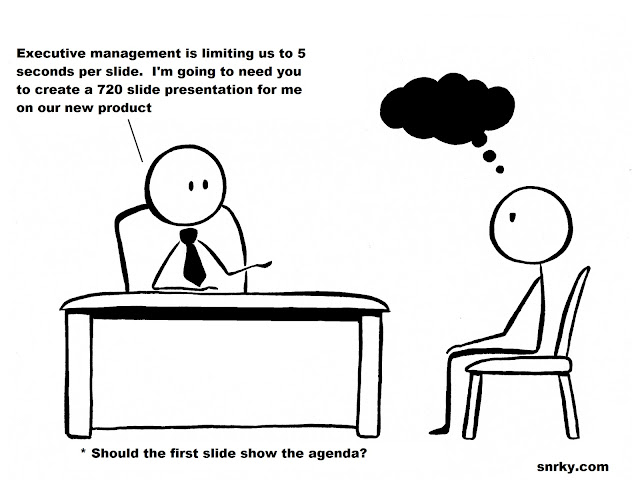
Should the first slide show the agenda?
This comic, if you're a regular follower of Snarky, is based on a comment I made last week about forcing work presentations to follow the Ignite model and stick to no more than five seconds per Power Point Slide (from Isn't That What You Said About Our Testing Resources Last Year?). I spend a lot of time reading about dystopias, and one of the general rules for writing your own dystopic literature is to take any basic fact about modern society and just go overboard with it until it's unhealthy. Basically, subvert the religious mandate, don't do anything to excess. So this comic is subverting the idea that 5 second slides might be healthy in a corporate environment.
If you're looking for a good dystopia, and you've already read The Handmaid's Tale, I just read Hugh Howey's Wool series. Although in some respects it fails my litmus test, for instance, by having hope, it's a good series. The first five books are pulled together in an omnibus edition. You can read it on a Kindle for $5.99, which is about $.01 per page. A good deal. I'm not quite through Will McIntosh's Soft Apocalypse yet, but I'm already enjoying it very much. And it definitely fits the extrapolation theme. As does Albert Brooks' (yes, that Albert Brooks) 2030: The Real Story of What Happens to America.
Snrky: Executive management is limiting us to 5 seconds per slide. I'm going to need you to create a 720 slide presentation for me on our new product.
Title: Should the first slide show the agenda?
Friday, March 30, 2012
Is it a (get up) stand up meeting?
Ah, stand up meetings. The only fifteen minute meeting that takes up 2 hours of your day when abused in a matrixed culture. However, all that standing up may make up for the mental stress:
The push for standing is not a new idea. In the Victorian era, standing desks were common for say, bookkeepers (think of Bob Cratchit in "A Christmas Carol"). In fact, it's still possible to find some of these high desks in antiques stores.
In ancient Greece, it was believed that people were sharper and more inspired if they stood rather than sat while working. Of course, certain jobs, such as teaching, have always required it.
Well-known historical "standers" at work included Abraham Lincoln and Winston Churchill.
And Dilbert is well-known for mocking stand ups: http://beyondlean.wordpress.com/2011/03/23/dilbert-tackles-stand-up-meetings/. Jumping jacks! Hasn't happened at my workplace yet, although some of the best decisions seem to be made over lunch or while playing Foosball.
Snarky: I am truly hoping management understands the irony of scheduling a ten minute meeting at 4:20 today.
Title: Is it a (get up) stand up meeting?
Labels:
Agile,
irony,
management,
Standups,
TC,
Two In a Cube
Wednesday, February 8, 2012
Tuesday, December 13, 2011
Tuesday, November 29, 2011
Friday, September 23, 2011
Friday, September 16, 2011
Wednesday, August 31, 2011
Subscribe to:
Posts (Atom)